In this post
The ESA Phi-Lab Spain team interviewed the head of the RISKCHAIN project: Alba Germán, data scientist and Earth observation specialist at Earthpulse. RISKCHAIN, one of the ESA Phi-Lab Spain projects, aims to develop a tool to anticipate risks in agricultural supply chains. It is an initiative led by Earthpulse in collaboration with Eurecat and the Fundación Empresa y Clima.
1. To begin with, what is RISKCHAIN and what is the main challenge it seeks to solve in agricultural and global supply chains?
RISKCHAIN is a risk simulator for agricultural and global supply chains.
Its main objective is to anticipate and manage vulnerabilities arising from climate change, supplier instability and increasing regulatory requirements. Many industries that depend on natural raw materials—such as food, cosmetics, fashion and pharmaceuticals—are facing increasingly frequent disruptions.
RISKCHAIN integrates satellite data, socio-economic information and artificial intelligence models to give businesses a clear picture of where they are exposed and how they can prepare.
2. Agriculture and industries that depend on natural raw materials are increasingly vulnerable to climate change, supplier instability and new regulations. Could you explain why it is so urgent to have tools that anticipate these risks?
The impacts of climate change are no longer hypothetical, and we can see them in the data: droughts, floods and regulatory changes are directly affecting the continuity of operations in the sector. When an agricultural raw material fails, the effect spreads rapidly throughout the global supply chain.
Although risks can be mitigated, without tools for anticipation, reactions are always late and more costly. In addition, companies face increasing costs to meet sustainability standards and maintain traceability. RISKCHAIN will help move from reactive management to proactive planning, improving resilience and competitiveness.
Although it can mitigate risks, without tools for anticipation, the reaction always comes too late and ends up being more costly.
Alba Germán, data scientist and Earth observation specialist at Earthpulse

3. RISKCHAIN combines satellite data, socio-economic information and artificial intelligence models to simulate scenarios and assess vulnerabilities. How does all this technology translate into practical, easy-to-use information for businesses?
RISKCHAIN simplifies and translates all the technological complexity, allowing users to interact with an intuitive dashboard that includes dynamic maps, risk indicators, and customised simulations.
To use RISKCHAIN, companies do not need to be experts in artificial intelligence or remote sensing. Users will receive clear information on which suppliers, regions or crops are most exposed and which variables (climate, regulation, resource availability) are most decisive.
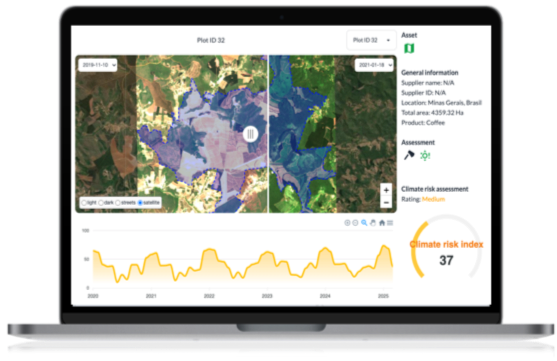
In addition, the tool will incorporate transparent explanations (explainable AI) that make it easier to understand why a risk is high and how to mitigate it.
4. Your simulator will enable testing of ‘what-if’ scenarios and the design of contingency plans. What specific benefits can it bring to sectors such as food, cosmetics, fashion, and pharmaceuticals, which depend on global agricultural chains?
Different sectors have different needs, but all reap very tangible benefits. In the food industry, for example, RISKCHAIN makes it possible to anticipate the impact of droughts on key crops and adjust supply plans. In cosmetics and perfumery, it can help protect sensitive value chains such as lavender, which are particularly exposed to climatic phenomena. In fashion and textiles, it facilitates the assessment of risks associated with cotton and other plant fibres to ensure continuity of production. Finally, in the pharmaceutical industry, it helps to ensure stability in the supply of plant-based raw materials used in active ingredients.
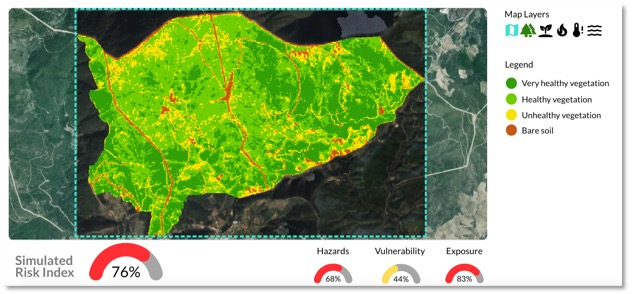
In all cases, we believe that the added value lies in the ability to test scenarios before they occur and design tailored responses that reduce losses and improve regulatory compliance.
5. The project brings together EarthPulse, Eurecat and the Fundación Empresa y Clima. How do your areas of expertise complement each other and what role do the partner companies play in the development and validation of the tool?
The strength of the project lies in its complementarity and the way we collaborate.
EarthPulse contributes its expertise in satellite analytics and the development of artificial intelligence solutions applied to environmental risk management. Eurecat contributes its leadership in applied research, climate modelling and advanced artificial intelligence methodologies. For its part, the Fundación Empresa y Clima guarantees a direct connection with the business community, identifying needs and validating use cases alongside leading companies in sectors such as food, cosmetics and fashion.
This robust ecosystem ensures that the tool is built on a solid scientific foundation while also responding to real market problems.
6. Beyond this initial phase, how do you envision RISKCHAIN evolution? Could it become a standard for companies to plan their global supply chains in a more resilient and sustainable way?
Our goal is for RISKCHAIN to become a practical and reliable reference for companies that want to anticipate risks and plan with greater resilience and sustainability. In this first phase, we aim to validate the simulator’s usefulness in specific sectors and with companies that already work with climate-sensitive agricultural commodities.
Looking ahead, the idea is to develop a solution that expands use cases, incorporates new variables, and facilitates integration with other management tools used by companies.
About the ESA Phi-Lab Spain
The ESA Phi-Lab Spain, based in Barcelona, is a leading competence centre dedicated to advancing innovation in the commercialisation of space technologies to support climate resilience
Its core mission is to accelerate the development of the space sector, covering both upstream and downstream activities, through projects that deliver significant commercial and societal value.
The programme is designed to foster the development of scalable and forward-looking solutions that respond to the growing need for climate resilience. It supports both mitigation and adaptation, helping societies and ecosystems respond to its impacts. ESA Phi-Lab Spain also plays a crucial role in enhancing local crisis management capabilities, particularly through the improved prediction and response to extreme weather events.
%20(2).png?noresize)